
Most event planning checklists you’ll find online are a list of nouns. Venue. Catering. Music. Decor. Useful for about ninety seconds, then useless, because they don’t tell you the thing that actually matters: what has to happen before what.
Event planning is a dependency problem. Your guest count determines your venue. Your venue determines your layout. Your layout determines your rentals. Your rentals determine your load-in schedule. Get the order wrong and you spend the last three weeks solving problems you created in week one.
This event planning checklist is organised by time, not by category. It comes from close to thirty years of producing corporate events, brand activations, galas and productions across Toronto and the GTA, which means it includes the unglamorous items that only surface when you’ve been on site at 5am watching a plan meet reality.
Work top to bottom. Adjust the timeline to your scale: a 40-person internal meeting compresses to a few weeks, a 500-person gala stretches past a year.
Phase 1: Definition (6 to 12 months out, or as early as you can)
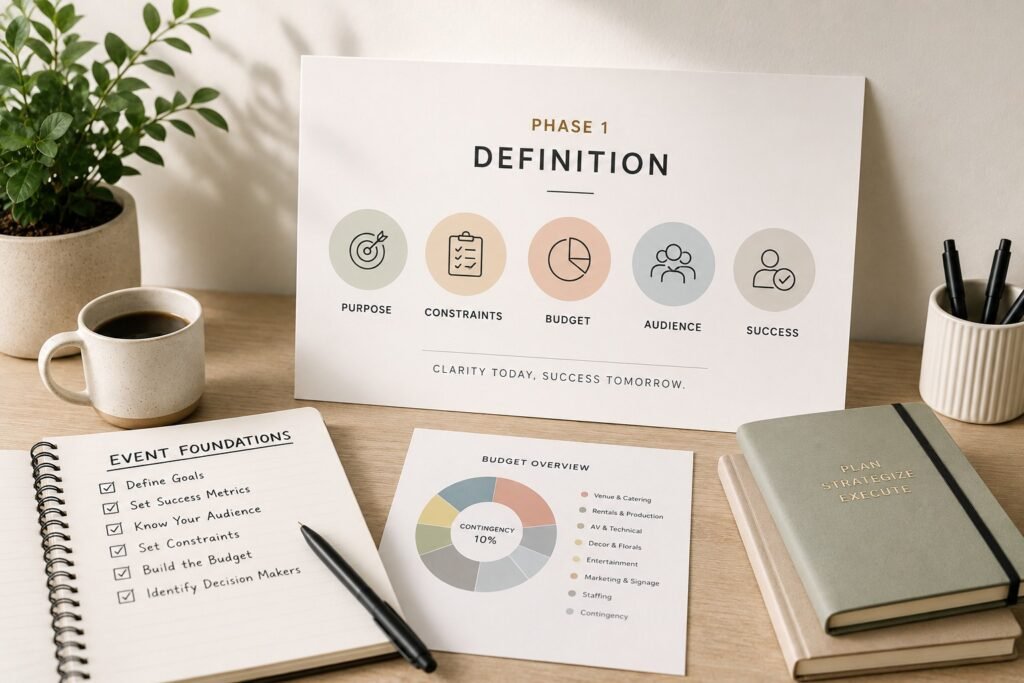
Nothing else can be decided until these are.
Purpose and success criteria
- Why does this event exist? Write one sentence. If you can’t, you’re not ready to book anything.
- What does success look like in numbers? Attendance, leads, funds raised, press pickup, internal engagement. Pick two or three and write them down.
- Who is the audience? Their expectations set your quality bar more than your budget does.
The non-negotiable constraints
- Target date and acceptable alternates
- Hard budget ceiling, not a wish
- Approximate guest count, with a range
- Format: seated dinner, reception, conference, activation, production, hybrid
- Decision-maker and sign-off chain. Who can say yes to spending, and who can only say no?
Budget structure
Build the budget before the wish list, not after. A working split for a mid-size corporate event:
| Category | Typical share |
| Venue and catering | 40 to 50% |
| Rentals, staging and production | 15 to 25% |
| AV and technical | 10 to 15% |
| Decor and florals | 8 to 12% |
| Entertainment and speakers | 5 to 15% |
| Marketing, print and signage | 3 to 5% |
| Staffing | 3 to 8% |
| Contingency | 10% |
That contingency line is not optional and it is not spare money. Something will change. It always does.
Phase 2: Foundations (4 to 6 months out)
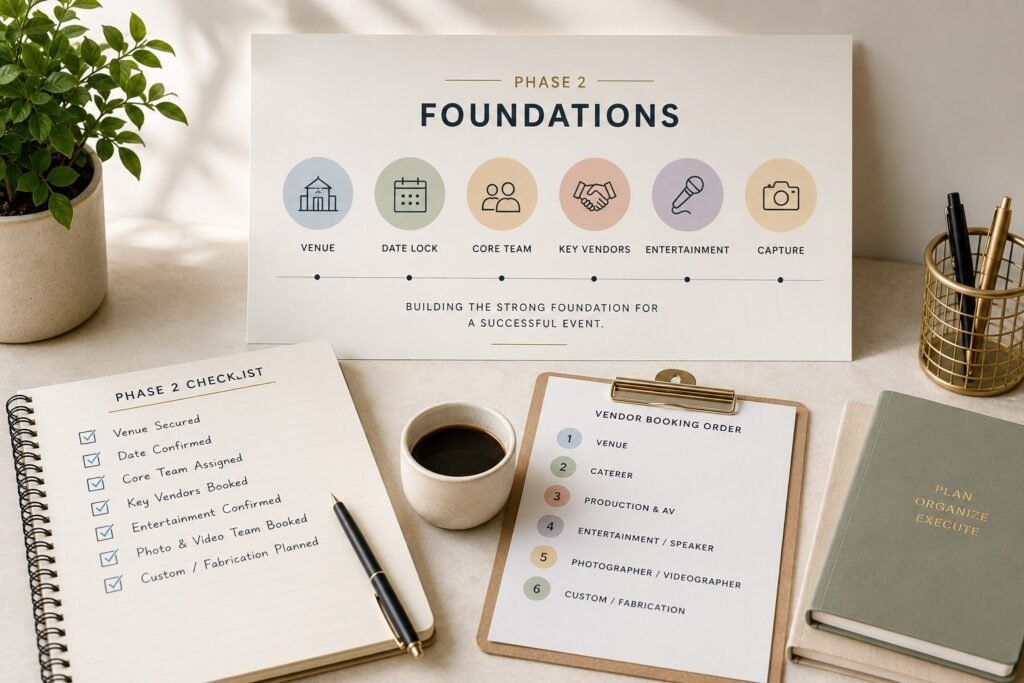
Venue
- Shortlist three venues and visit all three. Photographs lie about scale
- Confirm capacity for your format, not their headline number. A room that seats 200 theatre-style may seat 120 for dinner with a dance floor
- Get the inclusion list in writing: tables, chairs, linens, AV, staff, parking
- Check load-in access, dock, doorway and elevator dimensions, ceiling height
- Confirm access windows. What time can you get in, what time must you be out
- Ask about exclusive vendor requirements. Some venues force you to use their caterer or AV company
- Noise curfew, alcohol rules, decor restrictions, whether you can attach anything to walls
- Read the cancellation and postponement terms before signing
Date lock
- Cross-check against statutory holidays, school breaks, major sporting events and industry conferences
- Check what else is happening in the city that day. Traffic and hotel availability both matter
- For outdoor events, know your seasonal risk and set a weather contingency from day one
Core team
- Assign owners for: budget, venue liaison, vendors, marketing, guest experience, technical, day-of coordination
- One person owns each. Shared ownership means nobody owns it
Key vendors
Book in this order, because these are the ones that sell out:
- Venue
- Caterer
- Production and AV partner
- Entertainment or headline speaker
- Photographer and videographer
- Anything custom-built or fabricated
Phase 3: Build (2 to 4 months out)
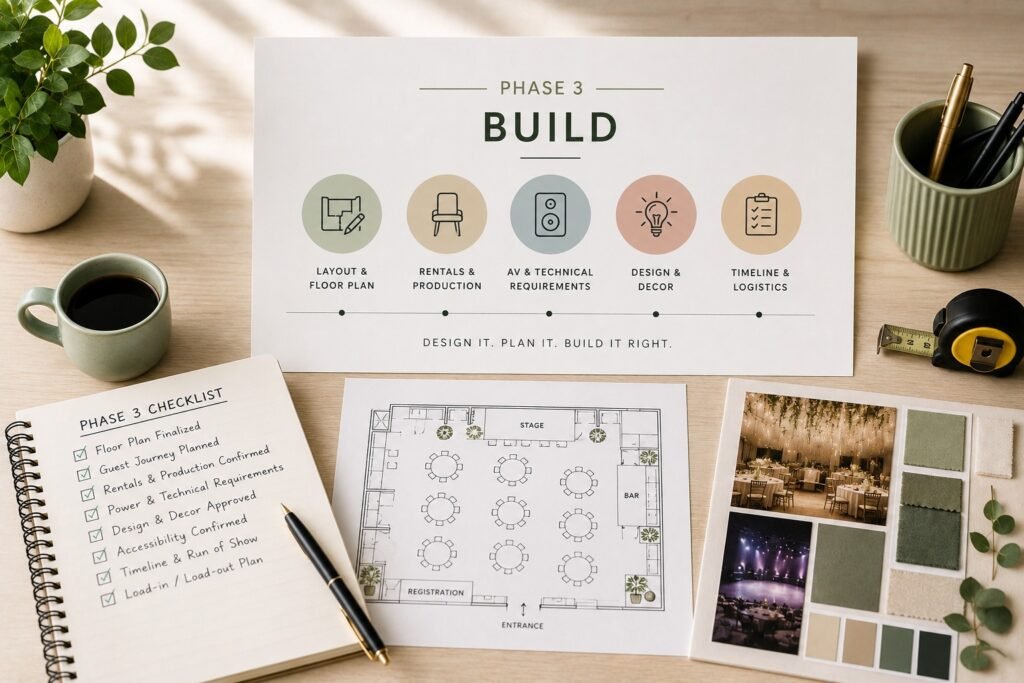
Floor plan and layout
- Draw it to scale. Not roughly, to scale
- Allocate space for the things people forget: dance floor, stage sightlines, buffet queues, bar queues, registration, coat check, back-of-house, AV control position
- Plan the guest journey from parking lot to seat. Walk it in your head, then walk it in person
- Confirm accessible routes, accessible seating and accessible washroom access
Rentals and production
- Finalise staging, flooring, drape, lighting and furniture against the floor plan
- Confirm power requirements across catering, AV, lighting and heating simultaneously
- Book custom fabrication now if you need it. Design and build time comes before availability
For the detailed version of this stage, including sizing tables and quantities, see our full event rental checklist.
Catering
- Menu tasting and sign-off
- Dietary requirements process, including how guests declare them and how servers identify them
- Bar package, service style, and whether you need a Special Occasion Permit from the AGCO
- Confirm staffing ratios. Roughly one server per 20 guests for buffet, one per 10 to 12 for plated
Programme and run of show
- Draft the run of show to the minute, from doors to last call
- Confirm speakers, their AV needs, and how long they’ll actually talk versus how long you’ve allotted
- Build in transition time. Room flips, speech-to-dinner, dinner-to-dancing all take longer than planned
- Rehearsal date for anything with a stage
Marketing and invitations
- Invitation design and send date. Corporate invites typically go 6 to 8 weeks out with a reminder at 2 weeks
- Registration or RSVP system, with a tracked deadline
- Event page, ticketing, or internal comms plan
- Social and press plan if the event is public
Compliance and paperwork
- Certificate of insurance from every vendor, naming the venue as additional insured if required
- Permits: tent, noise, street use, special occasion. Requirements vary by municipality across the GTA, so check with the specific local authority
- Fire code compliance: occupancy limits, aisle widths, exit access, flame ratings on fabric. Confirm with the venue and the local fire prevention office
- Health and safety plan, first aid provision, emergency procedure
- Contracts signed and filed in one place everyone can access
Phase 4: Confirmation (2 to 6 weeks out)
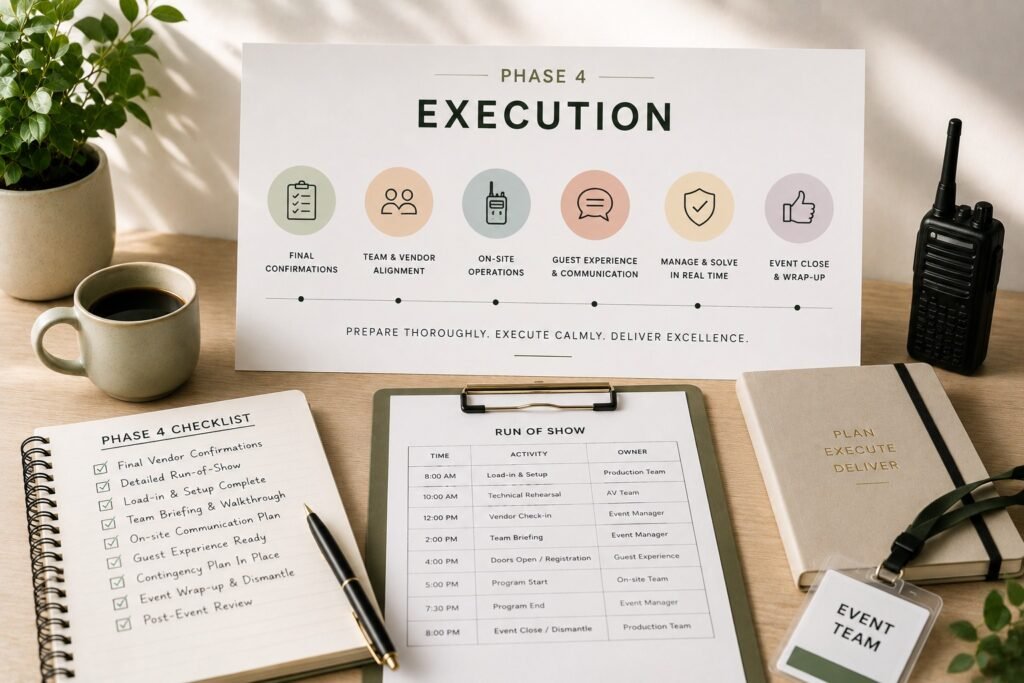
This phase is boring and it is where events are saved.
6 weeks
- Invitations out, RSVP tracking live
- Signage, print and branded material to production
- Confirm all vendor arrival times against the venue’s access window. Two trucks and one dock is a real problem
- Staffing roster drafted
4 weeks
- Registration or check-in process finalised, including the technology and the fallback if it fails
- Seating plan drafted
- Confirm AV requirements from every presenter, including file formats and adapters
- Photography shot list
2 weeks
- Final headcount to caterer and rental company, plus buffer
- Seating plan finalised
- Run of show circulated to all vendors and team leads
- Vendor contact sheet built: name, company, mobile number, arrival time, what they’re delivering
- Confirm delivery contact and who signs for what
1 week
- Reconfirm every vendor by phone. Not email, phone
- Print everything. Floor plan, run of show, contact sheet, seating chart, rental manifest
- Brief the team. Everyone should know their role and who to escalate to
- Check the weather forecast if any element is outdoors, and set your decision deadline
- Pack the kit: gaffer tape, zip ties, extension cords, batteries, scissors, marker, tape measure, first aid, spare adapters
Phase 5: The Day (event preparation checklist)
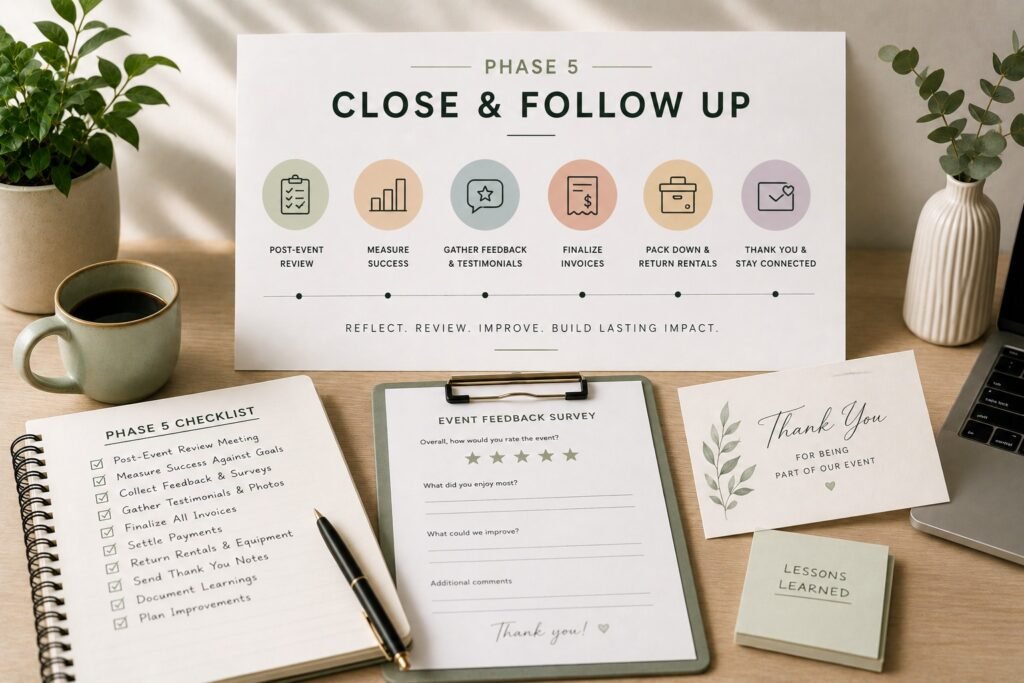
Before doors
- Arrive before the first delivery, not with it
- Count deliveries against the manifest before the truck leaves. Note damage on the paperwork immediately
- Confirm setup matches the floor plan, physically, not by assumption
- Test every microphone, every light, every screen, every presenter’s file
- Walk the guest journey from the parking lot
- Sit in the worst seat and check the sightline to the stage
- Confirm exits, extinguishers and accessible routes are clear and unobstructed
- Brief front-of-house staff on the run of show and the escalation contact
- Confirm catering timing against the run of show one final time
During
- One person owns the clock. Their only job is keeping the run of show on time
- Radio or group chat for the core team, agreed in advance
- Someone watching the room, not the programme. Temperature, queues, empty glasses, guests who look lost
- Track the things you’ll want to report on afterwards: attendance, engagement, whatever your success criteria were
Strike
- Clear guest belongings and lost property before teardown begins
- Consolidate rental items by category for pickup, and count out against the same manifest
- Return linens dry
- Photograph any damage
- Confirm venue sign-off on the space condition
- Confirm pickup times with every vendor before your crew leaves
Phase 6: After (within 2 weeks)
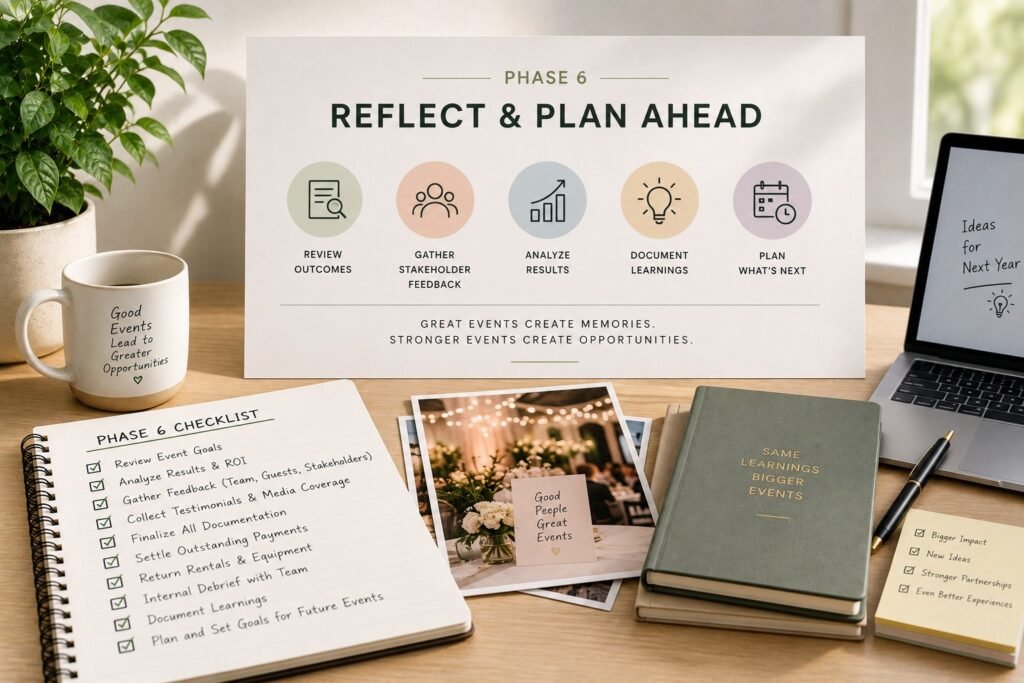
The phase almost everyone skips, and the one that makes the next event easier.
- Reconcile the budget: actual versus forecast, line by line
- Settle all vendor invoices and note any disputes while they’re fresh
- Measure against the success criteria you set in Phase 1
- Send the post-event survey within 48 hours, while memory is sharp
- Thank-yous to speakers, sponsors, vendors and staff
- Collect and file photography and video
- Hold a debrief within two weeks. What worked, what didn’t, what you’d change. Write it down
- Start the file for next year, while the detail is still in your head
The Ten Mistakes That Cause the Most Damage
From watching a lot of events come together, and a few come apart.
Booking the venue before confirming the format. A room that fits your guest count may not fit your guest count plus a stage, dance floor, bars and buffet.
No contingency, or spending it early. Ten percent, ring-fenced, untouched until week two of crisis.
Planning to invite count instead of attendance. Corporate RSVPs typically convert at 70 to 85 percent. Public events vary far more.
Underestimating transitions. A room flip from theatre to dinner takes staff and 30 to 45 minutes. Nobody ever budgets for it.
Ignoring load-in logistics until the week of. Dock access, elevator dimensions and vendor arrival conflicts should be solved in Phase 3.
No single owner for the clock on the day. Everyone assumes someone else is watching the time.
Assuming the venue’s capacity number applies to your event. It’s usually a theatre-style or standing figure.
No printed backup. Wi-Fi fails, phones die, batteries run out at exactly the wrong moment.
Skipping the site walk with your production and rental supplier. The venue coordinator knows the venue. Your supplier knows what will and won’t physically work in it.
No debrief. Every lesson gets re-learned at full cost next year.
The Condensed Version
If you take nothing else:
- Define purpose, budget and guest count before you book anything
- Book venue, caterer and production partner first, in that order
- Draw the floor plan to scale before you order rentals
- Confirm load-in access, power and ceiling height on a site walk
- Sort permits and insurance early, because they take weeks
- Final numbers two weeks out, phone reconfirmation one week out
- Print everything
- Count deliveries in and out against a manifest
- Someone owns the clock
- Debrief within two weeks
Frequently Asked Questions
How far in advance should I start planning an event? For a large corporate event, gala or conference, six to twelve months. For a mid-size internal event, three to four months. For a small meeting or party, four to six weeks. The constraint is rarely your own preparation, it’s vendor availability. Venues, caterers and production companies in the GTA book out furthest for May through September and December.
What should be on an event planning checklist first? Purpose, budget ceiling, guest count range and date. Every subsequent decision depends on those four. Booking a venue before settling them is the most common and most expensive planning mistake.
How much contingency should I budget for an event? Ten percent of total budget is the standard minimum. For outdoor events, first-time events or anything with complex production, fifteen percent is more realistic.
What’s the difference between an event planner and an event coordinator? Broadly, a planner works on strategy, budget, vendor selection and design across the full lead-up. A coordinator executes the plan, typically focused on the final weeks and the day itself. Small events often combine both roles into one person. Large events should not.
How do I work out how much space I need? Plan roughly 12 to 15 sq ft per person for a seated dinner with round tables, 6 to 8 for theatre-style seating and 5 to 8 for a standing reception. Then add the dance floor, stage, bars, buffet stations and circulation on top. Those extras are what turn a comfortable room into a cramped one.
What permits do I need for an event in Ontario? It depends on the event. Serving alcohol outside a licensed venue requires a Special Occasion Permit from the AGCO. Larger tents typically require a building permit, and thresholds and processes differ between Toronto, Mississauga, Vaughan and other GTA municipalities. Outdoor and public-space events may also need noise or street-use permits. Check with the specific municipality early, since approvals can take weeks.
When should I send invitations? Six to eight weeks ahead for corporate events, with a reminder at two weeks. Eight to twelve weeks for events requiring travel. Save-the-dates for anything more than three months out.
What should I do immediately after the event? Reconcile the budget, send the survey within 48 hours, thank your vendors and hold a debrief within two weeks. The debrief is the highest-value hour in the entire process and it’s the one people skip.
The Point of a Checklist
A checklist doesn’t make an event good. Judgement, taste and the right partners do that. What a checklist does is stop the avoidable failures from eating the attention you need for the parts that actually matter.
If you’re at the stage where the plan needs to become a physical room, that’s the part we do. Happy to look over a floor plan or a production list before you commit to anything.
About the author
Cool Set Productions has been producing events across Toronto and the Greater Toronto Area for close to thirty years. What began as a small staging operation in East York now covers staging, pipe and drape, event rentals, custom fabrication and full event production for corporate events, shopping centre activations, brand launches, theatrical productions and private celebrations throughout Toronto, Mississauga, Oakville, Richmond Hill, Vaughan, Markham and Hamilton. The timelines above come from actual load-ins and strikes, not from a template.
Questions about a specific event? Call (416) 405-8882 or email hello@coolset.ca.